
How to Calculate Percentage: Formula, Examples & Step-by-Step Guide
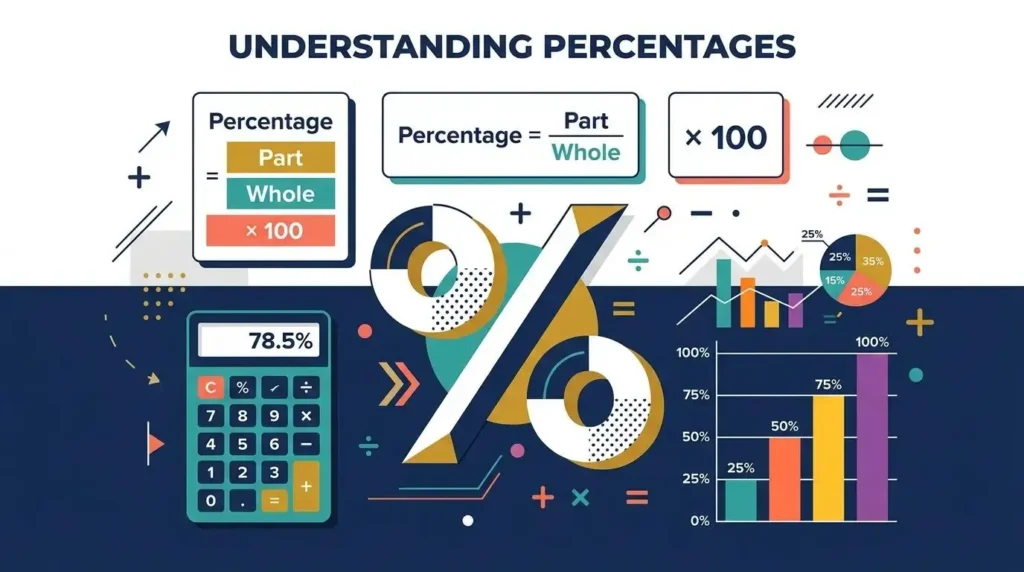
Percentages are used in everyday life, from calculating shopping discounts and exam scores to understanding price changes and financial figures. Learning how to calculate a percentage makes these tasks much easier.
In this guide, you will learn the basic percentage formula, how to find a percentage of a number, and how to calculate percentage increases and decreases. Each method includes simple examples and practical situations so you can understand how the calculations work.
What Is a Percentage?
A percentage is a way of expressing a number as a fraction of 100. The word percentage means “per hundred.” The symbol used for percentage is %.
For example:
- 25% means 25 out of 100.
- 50% means 50 out of 100, or one-half.
- 75% means 75 out of 100, or three-quarters.
- 100% means the entire amount.
- 150% means 150 out of 100.
Percentages make it easier to compare values, understand proportions, and measure changes.
What Is the Percentage Formula?
The basic formula for calculating a percentage is:
Basic Percentage Formula
Percentage = (Part ÷ Whole) × 100
Here:
- Part: The amount you want to compare.
- Whole: The total amount.
- 100: Converts the fraction into a percentage.
Example: If you scored 45 marks out of 60, divide 45 by 60 and multiply the result by 100.
(45 ÷ 60) × 100 = 75%
Your score is 75%.
How to Calculate a Percentage of a Number
Sometimes you know the percentage and the total number, and you want to find the actual amount.
Use this formula:
Percentage Amount Formula
Percentage Amount = (Percentage ÷ 100) × Total
Example: What is 20% of 150?
- Convert 20% into a decimal by dividing it by 100.
- 20 ÷ 100 = 0.20.
- Multiply 0.20 by 150.
- 0.20 × 150 = 30.
Therefore, 20% of 150 is 30.
Real-Life Example: Calculating an Exam Score
Suppose a student scores 42 marks out of 50 in an exam. To calculate the percentage, divide the marks obtained by the total marks and multiply by 100.
Calculation
(42 ÷ 50) × 100 = 84%
The student scored 84% in the exam. This method can be used for school tests, college exams, and other assessments.
How to Calculate Percentage Increase
Percentage increase tells you how much a value has grown compared with its original value.
Use this formula:
Percentage Increase Formula
[(New Value − Original Value) ÷ Original Value] × 100
Example: A product’s price increases from $80 to $100.
- Subtract the original price from the new price: 100 − 80 = 20.
- Divide the increase by the original price: 20 ÷ 80 = 0.25.
- Multiply by 100: 0.25 × 100 = 25%.
The price increased by 25%.
Real-Life Example: Monthly Salary Increase
Suppose an employee’s monthly salary increases from $2,000 to $2,300.
- Find the increase: $2,300 − $2,000 = $300.
- Divide the increase by the original salary: 300 ÷ 2,000 = 0.15.
- Multiply by 100: 0.15 × 100 = 15%.
The employee received a 15% salary increase.
How to Calculate Percentage Decrease
Percentage decrease measures how much a value has fallen compared with its original value.
Use this formula:
Percentage Decrease Formula
[(Original Value − New Value) ÷ Original Value] × 100
Example: A product’s price drops from $120 to $90.
- Find the difference: 120 − 90 = 30.
- Divide the difference by the original price: 30 ÷ 120 = 0.25.
- Multiply by 100: 0.25 × 100 = 25%.
The price decreased by 25%.
How to Calculate a Discount Amount
Discount percentages help you understand how much money you save when buying an item on sale.
Use this formula:
Discount Amount Formula
Discount Amount = Original Price × (Discount Percentage ÷ 100)
Example: A jacket costs $80 and has a 15% discount.
- Convert 15% into a decimal: 15 ÷ 100 = 0.15.
- Multiply the original price by the decimal: 80 × 0.15 = 12.
- Subtract the discount from the original price: 80 − 12 = 68.
You save $12, and the final price is $68.
Want to calculate a discount quickly? Try our Discount Calculator to find your savings and final sale price.
Real-Life Example: Shopping Discount
Imagine you are buying shoes with an original price of $120. The store offers a 25% discount.
- Calculate 25% of $120: 120 × 0.25 = $30.
- Subtract the discount: 120 − 30 = $90.
You save $30 and pay $90 for the shoes before any applicable taxes or additional charges.
Common Percentage Calculation Mistakes
Even simple percentage calculations can become confusing if the wrong value is used as the starting point. Avoid these common mistakes:
- Using the wrong total: Always identify the whole amount before applying the basic percentage formula.
- Forgetting to multiply by 100: Dividing the part by the whole gives a decimal. Multiply by 100 to express it as a percentage.
- Using the new value as the original value: Percentage increase and decrease are normally calculated using the original value as the denominator.
- Confusing percentage points with percentages: An increase from 20% to 25% is 5 percentage points, but a 25% relative increase.
Quick Percentage Formula Reference
- Find a percentage: (Part ÷ Whole) × 100
- Find a percentage amount: (Percentage ÷ 100) × Total
- Percentage increase: [(New − Original) ÷ Original] × 100
- Percentage decrease: [(Original − New) ÷ Original] × 100
- Discount amount: Original Price × (Discount Percentage ÷ 100)
Frequently Asked Questions
How do I calculate 10% of a number?
Divide the number by 10. For example, 10% of 250 is 25.
How do I calculate 50% of a number?
Divide the number by 2. For example, 50% of 80 is 40.
How do I find what percentage one number is of another?
Divide the first number by the second number and multiply the result by 100. For example, 30 is 20% of 150 because (30 ÷ 150) × 100 = 20%.
Can a percentage be greater than 100%?
Yes. A percentage can exceed 100% when the amount being compared is greater than the reference amount. For example, 150 is 150% of 100.
What is the difference between percentage increase and percentage decrease?
Percentage increase measures growth from an original value, while percentage decrease measures a reduction from an original value. Both use the original value as the reference amount.
Can I calculate a percentage without a calculator?
Yes. You can use the percentage formula and perform the division and multiplication manually. For simple percentages, dividing by 10 finds 10%, and dividing by 2 finds 50%.
Final Thoughts
Percentage calculations become easier when you understand the basic formula and know which values to use. Whether you are working out exam scores, comparing prices, calculating discounts, or measuring changes, the same basic principles can help you get accurate results.
Explore the OwnCalculate calculator directory for more practical calculation tools and clear explanations.